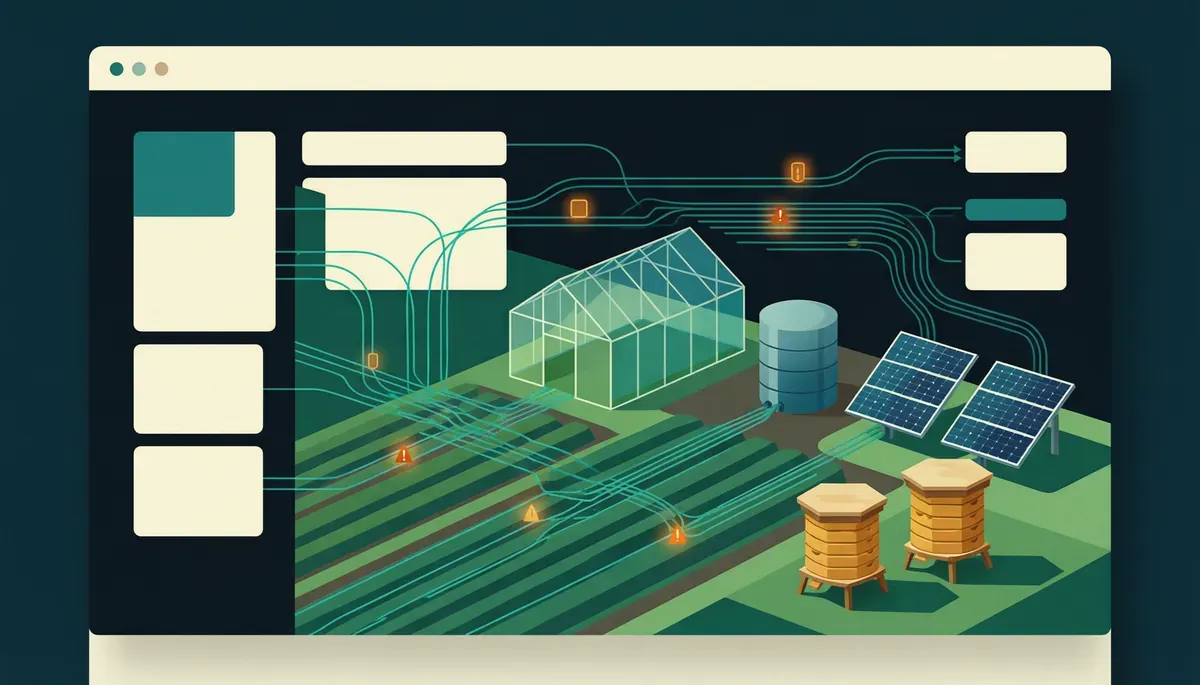
Responde a:¿Cuándo exactamente los subsistemas diseñados (energético, hídrico y ciclo de nutrientes) alcanzarán el punto de operación simultánea?Media
Hipótesis:Los tres subsistemas (energético, hídrico y ciclo de nutrientes) no alcanzarán operación simultánea hasta que el más lento —probablemente el ciclo de nutrientes, que depende de biología— complete su primer ciclo completo de maduración, estimado en 18-24 meses desde la instalación.
Evidencia esperada:Modelo de secuencia de interdependencia documentado en el mapa ancla Iwagé. Cada subsistema tiene hitos medibles: panel solar instalado (energético ✓ parcial), captación de lluvia operando (hídrico ✓ parcial), biodigestor diseñado pero no construido (nutrientes ✗).
Responde a:¿La secuencia de interdependencia identificada (hídrico → riego → energético → automatización → datos) se confirma en la práctica o es un artefacto de modelado?Media
Hipótesis:La secuencia de interdependencia (hídrico → riego → energético → automatización → datos) refleja el orden real de dependencias técnicas del sistema. Invertir el orden (empezar por automatización antes de tener agua y energía) produciría un sistema que funciona en teoría pero no en campo.
Evidencia esperada:Documentación de la secuencia de construcción real en el corredor Ambalá-Calambeo. Cada paso de la secuencia tiene una dependencia documentada del anterior: sin agua no hay riego, sin riego no hay cultivo que justifique automatización, sin energía no hay sensores.
Última evolución:August 30, 2026
Motivo de evolución:Parte de: Iwagé — Sistema Autosustentable
El Grafo Cognitivo
↑ Deriva de:
📝Sistema autosustentable Iwagé: mapa de un proyecto en construcción
Home Assistant y el gemelo digital de la granja tiene su origen en Sistema autosustentable Iwagé: mapa de un proyecto en construcción
📐Arquitectura de gemelo digital en tres capas (HA + InfluxDB + Grafana)
Arquitectura de gemelo digital en tres capas (HA + InfluxDB + Grafana) deriva de home-assistant
📐Salvaguarda física independiente de red (failover de automatización)
Salvaguarda física independiente de red (failover de automatización) deriva de home-assistant
📐Falla silenciosa como modo de fallo crítico
Falla silenciosa como modo de fallo crítico extraido de home-assistant
→ Se aplica en:
🔗Granja Peri-urbana Autosustentable
Bitácora que documenta el gemelo digital de la granja
🔗Resiliencia Operativa en Flujos de Producción
Home Assistant y el gemelo digital de la granja se clasifica en Resiliencia Operativa en Flujos de Producción (derivado de campo categoria)
🔗IoT Rural y Sensores de Campo
Home Assistant y el gemelo digital de la granja se clasifica en IoT Rural y Sensores de Campo (derivado de campo categoria)
📐Modo degradado como criterio de diseño
Salvaguarda física es aplicación directa
📐Energía soberana
Energía soberana se aplica en home-assistant
❓¿Cuándo exactamente los subsistemas diseñados (energético, hídrico y ciclo de nutrientes) alcanzarán el punto de operación simultánea?
¿Cuándo exactamente los subsistemas diseñados (energético, hídrico y ciclo de nu se materializa en Home Assistant y el gemelo digital de la granja
❓¿La secuencia de interdependencia identificada (hídrico → riego → energético → automatización → datos) se confirma en la práctica o es un artefacto de modelado?
¿La secuencia de interdependencia identificada (hídrico → riego → energético → a se materializa en Home Assistant y el gemelo digital de la granja
🔗Granja Peri-urbana Autosustentable
El gemelo digital automatiza esta granja
↓ Sustenta a:
📐Arquitectura de gemelo digital en tres capas (HA + InfluxDB + Grafana)
Arquitectura de gemelo digital en tres capas (HA + InfluxDB + Grafana) proporciona fundamento a Home Assistant y el gemelo digital de la granja
📄MDPI, Applied Sciences (2026). A Digital Twin-Enabled Framework for Agrivoltaic System Design, Simulation, Monitoring and Control
Fuente citada en el nodo
📄Aguacatec (2025-2026). Automatizar el riego con Home Assistant
Fuente citada en el nodo
📄Programarfacil.com (2024). Sistema de riego con Home Assistant
Fuente citada en el nodo
📄InfluxData (2026). How to Integrate Grafana with Home Assistant in 2026
Fuente citada en el nodo
📄The Home Smart Home (2026). Home Assistant: InfluxDB & Grafana for Data Enthusiasts
Fuente citada en el nodo
📄tutoriales.com (2026). Control Inteligente de Riego Agrícola con ESP32 y Plataforma IoT
Fuente citada en el nodo
Ramificaciones futuras
Preguntas abiertas del catálogo que este nodo toca o ayuda a responder. Click en una para ver todos los nodos del jardín que la exploran:
- ¿Cuándo exactamente los subsistemas diseñados (energético, hídrico y ciclo de nutrientes) alcanzarán el punto de operación simultánea?Los tres subsistemas (energético, hídrico y ciclo de nutrientes) no alcanzarán operación simultánea hasta que el más lento —probablemente el ciclo de nutrientes, que depende de biología— complete su primer ciclo completo de maduración, estimado en 18-24 meses desde la instalación.
- ¿La secuencia de interdependencia identificada (hídrico → riego → energético → automatización → datos) se confirma en la práctica o es un artefacto de modelado?La secuencia de interdependencia (hídrico → riego → energético → automatización → datos) refleja el orden real de dependencias técnicas del sistema. Invertir el orden (empezar por automatización antes de tener agua y energía) produciría un sistema que funciona en teoría pero no en campo.