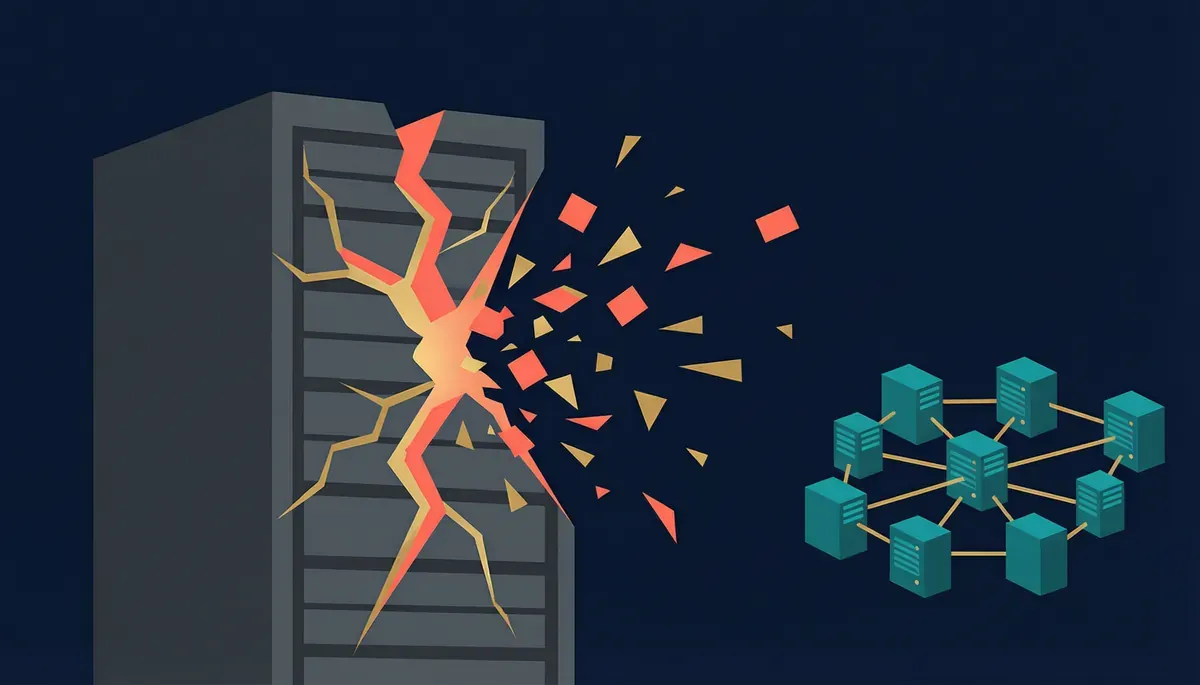
Summary: On June 12, 2026, Anthropic globally disabled access to Fable 5 and Mythos 5 in compliance with a U.S. government export control directive. The blackout lasted more than eleven days for all users on the planet. This node documents what exactly happened, why it occurred, and the three concrete architectural decisions I made in response — not as an emotional reaction but as a correction of a fragility that already existed before the event. Useful for developers, technical consultants, and teams operating with AI in production who want to understand what risk variables were not in their decision model.
On June 12, 2026, at 5:21 PM ET, Anthropic received a directive from the U.S. Department of Commerce citing national security authorities. Within hours, Fable 5 and Mythos 5 were disabled for all customers worldwide — without exception by country, account type, or contract level.
It was not an infrastructure failure. It was not a security incident. It was a government order executed in real-time on a product in production.
Eleven days later, both models remained offline.
What Happened Exactly and Why It Matters to Understand It Well
The reported trigger was that Amazon — an investor with up to $25 billion committed to Anthropic — demonstrated to the Department of Commerce a jailbreak technique on Fable 5. The administration interpreted this as a national security risk and issued the directive.
Anthropic disputed the characterization: it argued that the technique was narrow, not universal, and also present in competitors' models. The technical argument may be valid. It did not change the operational outcome.
The compliance problem that caused the global blackout is technically interesting: the directive ordered blocking access to foreign citizens inside and outside the U.S. Since Anthropic cannot verify nationality in real-time at the account level, the only way to comply was to disable the model for everyone. An identity verification problem became a global access restriction.
For a developer or consultant who had Fable 5 integrated into production, the outcome was identical regardless of where they lived, what contract they had, or how critical the use was: the model stopped responding.
Why This Was Not a Surprise for Those Watching the Context
The episode did not emerge from nowhere. There are two precedents that contextualize it:
In February 2026, the Pentagon designated Anthropic as a "supply chain risk" — the same category that has historically been applied to Huawei or ZTE. The reason: Anthropic refused to remove two clauses from its contracts that prohibited mass surveillance of American citizens and autonomous weapons without human oversight. Anthropic filed lawsuits in two federal courts in response. The company was in active conflict with the federal government before Fable 5 existed.
In June 2026, days before the launch of Fable 5, Anthropic confidentially filed for its IPO with a valuation close to $350 billion. The blackout occurred eight days after the launch. Regulatory risk became a variable that investors had to incorporate into their models.
For those building stacks on third-party infrastructure, the lesson is not that Anthropic is unreliable — it is that any provider operating under a jurisdiction with unilateral intervention capability is a potential point of failure that the architecture must account for.
The Three Decisions I Made in Response
I did not change providers. I changed the architecture so that no provider is a single point of failure.
First Decision: Separate the Model from the Flow
Before the episode, several flows in n8n had the model hardcoded — claude-sonnet-4-6 in the API call node, with no fallback. If the model did not respond, the flow failed.
After the episode, all critical flows have a configuration variable LLM_PROVIDER and LLM_MODEL that can be changed without touching the flow code. The model is a configuration parameter, not a structural dependency. Switching from Claude to DeepSeek V4 in a production flow now takes less than two minutes.
Implementation cost: approximately four hours of refactoring per complex flow, less for simple flows. It is worth doing it just once.
Second Decision: Have at Least One Self-Hosted Model Active at All Times
Ollama with Qwen3 runs on a local server in the Ambalá-Calambeo corridor. It is not the most powerful model in the stack. It is the model that can never be shut down by a U.S. government directive because it does not run on U.S. infrastructure.
For medium-volume tasks — classification, summarization, draft generation, structured extraction — the quality difference compared to frontier models is tolerable. For tasks requiring complex reasoning or difficult coding, it is still necessary to scale to cloud models. But the self-hosted model resolves the contingency scenario: if all cloud providers fail simultaneously, the operation does not stop.
The cost of keeping this active is low — electricity and the hardware that already exists. The cost of not having it when needed is potentially high.
Third Decision: Document the Jurisdictional Dependency Map of the Stack
This did not exist before the episode and should have existed from the start.
The map answers a simple question for each component of the stack: under what jurisdiction does this service operate and what could that jurisdiction do to interrupt my access?
| Component | Provider | Jurisdiction | Risk of Interruption |
|---|---|---|---|
| Main LLM | Anthropic (Claude) | U.S. | Regulatory — demonstrated |
| Secondary LLM | DeepSeek | China | Regulatory — theoretical |
| Local LLM | Ollama + Qwen3 | None | Hardware/Energy — local |
| Automation | n8n self-hosted | None | Hardware/Energy — local |
| CMS | Strapi self-hosted | None | Hardware/Energy — local |
| Database | PostgreSQL self-hosted | None | Hardware/Energy — local |
The pattern that emerges: components that are not self-hosted have jurisdictional risk. Those that are have local infrastructure risk. They are risks of different natures that are mitigated in different ways.
DeepSeek as an alternative to Claude resolves the American jurisdictional risk but introduces Chinese jurisdictional risk — under Chinese law, processed data may be accessible to authorities. For projects with sensitive customer data, that is not an improvement. For projects where data sensitivity is low and cost matters, it may be. The decision depends on the case, not on a general preference for a provider.
What the Episode Did Not Change
I did not stop using Claude. Sonnet and Opus were not affected by the directive and remain in the stack for tasks where their quality is relevant. The assessment of Anthropic as a provider did not change negatively — what changed is that I now know that any provider under American jurisdiction can be interrupted and that is a design variable, not a value judgment about the company.
I also did not adopt the position that Chinese models are inherently more reliable. They have a different jurisdictional risk, not lesser. Diversification is not migrating from one provider to another — it is ensuring that no individual provider is indispensable.
What I Still Do Not Have Resolved
The automation of failover. The dependency map exists as a document — not as a system that automatically detects when a provider is unresponsive and redirects traffic to the next available one. That would require an orchestration layer over n8n that I have not built yet. When I have it documented, I will update this node.
Also: I do not know if the Fable 5 episode was an isolated event or the beginning of a pattern. If the U.S. government demonstrated that it can and wants to intervene in AI models at this speed, the regulatory variable becomes more relevant in long-term architectural decisions. I am observing how it evolves before taking more definitive positions.
If you have hardcoded AI models in production flows, the most urgent question is not which model is better — it is how long it would take you to switch providers if the one you are using today disappeared tomorrow. That time is your real exposure to risk.