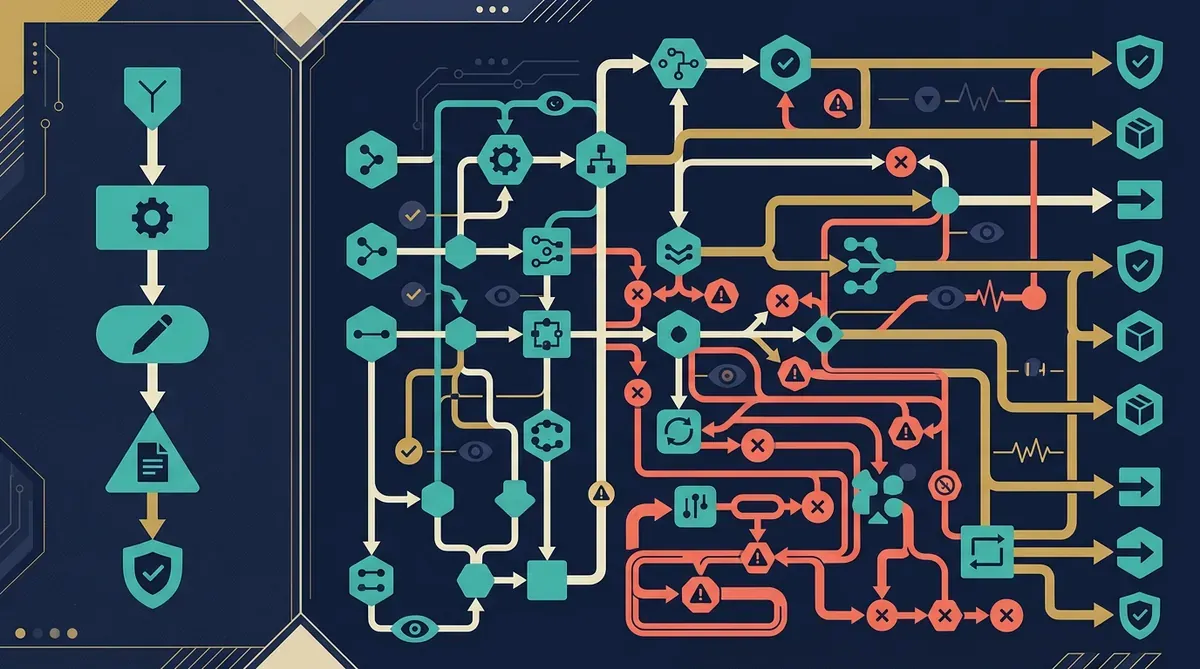
Responde a:What flow architecture patterns —beyond the tutorial— determine that an n8n automation is reliable in real production without constant supervision?Media
Hipótesis:The difference between an n8n flow that works in a tutorial and one that operates in real production lies in four patterns: validate before processing, respond fast and process slow (webhook), log every execution in a database, and detect silent failures.
Evidencia esperada:Primer flujo de producción falló silenciosamente por 3 días (datos incorrectos sin error visible). Los 4 patrones documentados emergieron de esa falla y de iteraciones posteriores. Flujos actuales operando en Hub Soberano con registro completo de ejecuciones.
Planted:June 23, 2026
Last evolution:June 28, 2026

Abstract: n8n tutorials show the ideal case — everything arrives well, everything responds well, everything works. This node documents what comes next: why flows fail in production, how to build them so they don't fail, and why AI doesn't replace n8n but makes it faster. All from real flows operating in the Sovereign Hub from the Ambalá-Calambeo corridor. Useful for makers who have already seen the first tutorial and want to build something that works without being on top of it.


The first production flow I built in n8n had twelve nodes, worked perfectly in my tests, and failed silently the first real week. It didn't throw a visible error — it simply processed incorrect data without saying so. I discovered it three days later while manually reviewing the logs.

The problem wasn't n8n. It was that I had built the flow assuming that the data would always arrive in the format I expected. In production, data rarely has the format one expects.

From that flow, I learned to build differently.

First: What is n8n for if AI can do the same?

It's the question I hear most among AI enthusiasts today. And it has some truth — Claude, ChatGPT, or any coding agent can generate a Python script that calls an API, transforms data, and writes to a database. That works.

But there are four things that this script doesn't have by default and that n8n does:

Ready-to-use triggers. n8n listens to webhooks, executes scheduled tasks, reacts to WhatsApp messages, changes in Strapi, database events — all from the interface, without configuring additional servers. A Python script needs its own infrastructure to do the same.

Automatic retries and error handling. When an n8n flow fails, n8n can notify you via Telegram, log the error, retry automatically, and escalate for manual review. A Python script fails silently until someone reviews it — or until the client calls.

Pre-existing connectors. n8n has over 1,300 native integrations that already handle authentication, pagination, and specific formats for each API. Replicating that with AI for each integration is possible — but takes time and produces code that needs to be maintained.

Operability without the author. An n8n flow can be understood and adjusted by someone without coding knowledge. An AI-generated Python script can only be maintained by someone who understands Python and the logic of the script. That doesn't matter when you work alone — it matters when you delegate or when you return to the script six months later.

What has changed with AI: the time to build flows has decreased by 60 to 80%. It's not n8n vs AI — it's n8n with AI. AI generates the complex code nodes, n8n connects and operates them. The two together are faster than either alone.

Why flows fail in production

The most common reason is not a bug in the core logic. It's that the flow was built assuming everything will arrive well.

In production, these things happen all the time:

A webhook arrives with an empty field or unexpected format. The flow processes that broken data without realizing it and produces an incorrect result — without throwing any error.

An external API takes longer than normal. n8n considers it failed and retries. The external process had already completed correctly. The result: the same process runs twice.

The service sending the webhook doesn't receive quick confirmation and retries automatically. The flow receives the same message twice and processes it twice.

A flow that calls an API 500 times in a row hits the limit of allowed calls. n8n retries, the API keeps rejecting, the flow gets stuck until someone cancels it manually.

None of these problems appear in tutorials because tutorials use perfect data and APIs that always respond.

How I build flows that survive production

I learned to think of each flow in layers, not as a linear sequence of nodes.

Validate first, process later. Before doing anything with the data that arrived, I check that it has what the flow needs. If something is missing or arrives in the wrong format, the flow ends cleanly and logs what went wrong. Not silently, not with incorrect data — it ends and notifies.

Respond quickly, process slowly. For flows triggered by webhook, the first thing the flow does is confirm receipt — it responds "received" in milliseconds. The actual processing occurs in a separate subflow that takes the time it needs. This way, the service that sent the webhook doesn't retry because it thought it failed.

Log every execution. Each production flow writes to a simple table in PostgreSQL: when it started, when it ended, whether it worked or not, and what error occurred if something went wrong. This allows me to detect flows that started but never finished, and understand error patterns without opening n8n logs.

Configure, don't hardcode. Credentials, API URLs, and AI model names live in configuration variables — never written directly in the nodes. A flow without fixed values in its nodes can be moved between environments and updated without the risk of breaking something.

Pause between repeated calls. If a flow needs to call an API many times in a row, a pause node between calls prevents hitting the API limits. Redis as a queue does the same more elegantly when the volume is high.

How I integrate AI models within flows

In the Sovereign Hub, almost all information processing flows have at least one AI node. What I learned to do differently from tutorials:

The model is never hardcoded in the node. It lives in a configuration variable. Switching from Claude Sonnet to DeepSeek V4 Flash in a flow takes less than two minutes — without touching any node, just changing the variable. This was critical when Fable 5 was shut down in June 2026 and several flows depended on Anthropic models.

The prompt lives as a template with spaces for data — not built by concatenating text in the node. This makes it easier to adjust without breaking the flow and allows testing with sample data before taking it to production.

The model's response is always validated before use. Models sometimes wrap the JSON in additional text or slightly change the format. A small node that extracts and verifies the JSON before passing it to the next node avoids hard-to-trace errors.

If the main model doesn't respond, the flow tries the backup model before failing. In my stack: DeepSeek V4 Flash as primary for volume tasks, Qwen3 local via Ollama as backup if DeepSeek is unavailable.

What I learned operating from the field with variable connection

The Ambalá-Calambeo corridor doesn't have a stable connection. What sounds like a problem turned out to be the best resilience testing environment I could have.

Flows that fail when the connection drops to 2G have very short timeouts or lack reconnection handling. Since I operate from the field, all my timeouts for calls to external APIs are set to a minimum of 30 seconds — not the default of 10 seconds. And the flows that process field data — meliponiculture records, GPS coordinates of traps — are designed to work offline and synchronize when there is a connection, not to require constant connection.

That last point is still not completely resolved for all field forms. When it is documented, this node will be updated.

What I still haven't resolved

Uptime Kuma monitors whether n8n is available as a service — not if a specific flow is failing silently. The execution table in PostgreSQL is my current detection system, but it requires manual review. Automatic alerts about anomalies in that table are pending.

Automatic failover of models also doesn't exist at the flow level yet. If DeepSeek doesn't respond, the flow goes to the error workflow instead of redirecting to Ollama automatically. It's on the list — but it's still not done.


If you have an n8n flow that works in testing but fails in production, it's most likely missing a validation layer at the start or error handling that assumes APIs always respond well. Those two things are what tutorials omit and what saves the most time once they are well built.


Sources cited in this node:

  • Flowlyn.com — n8n 230,000 active users, November 2025
  • Sacra.com — n8n ARR $40M, valuation $2.5B Series C, October 2025
  • Highland Europe — n8n Series B €55M, ARR growth 5x, March 2025
  • Hostinger / Automation Trends 2026 — automation market $23.77B → $37.45B, January 2026
  • Medium / MissionsDone — 75% of n8n clients using AI features, July 2025
  • BrowserAct.com — reduction of construction time 60-80% with templates and AI, 2025
  • Direct field observation — Sovereign Hub, Ambalá-Calambeo corridor, 2025-2026
The Cognitive Graph
Urgent For a limited time

A "half-broken" piece of furniture or structure in your Airbnb costs 4× more in negative reviews than fixing it on time.

Design my structure →
Data Verified data

Projects with prior 3D modeling reduce manufacturing errors by 80% and material waste by 30%.

View technical cases →