Responde a:Are cross-domain learning transfers a scientifically documented phenomenon or an anecdotal observation from personal experience?Media
Hipótesis:There is scientific evidence supporting the transfer of learning between different domains.
Evidencia esperada:Revisión sistemática de literatura y comparación con el caso documentado.
Responde a:What is the most honest way to measure whether the personal source code (filters) is producing better decisions over time, without self-justification bias?Media
Hipótesis:Personal filters can be evaluated using objective indicators related to projects, clients, and collaborators.
Evidencia esperada:Métricas históricas, resultados de proyectos y análisis longitudinal.
Planted:June 10, 2026
Last evolution:July 21, 2026

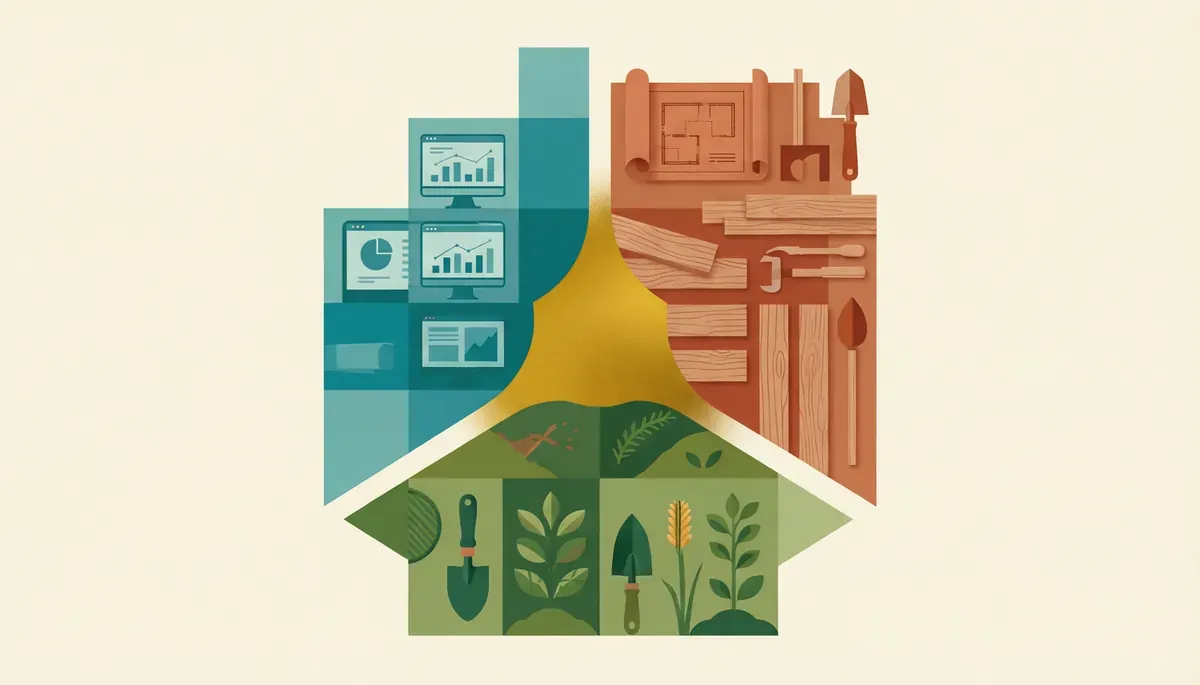
Why do three territories produce something that one alone cannot?

The WEF Future of Jobs Report 2025 estimates that 39% of core job skills will change by 2030. The SHRM Automation/AI Survey 2026 recorded that automation in the computing and mathematics group rose from 32% to over 50% of highly automated tasks in just one year.

In this context, hyper-specialization is a structural risk — the perfect screw without a machine to fit into. But the answer is not to accumulate skills indiscriminately. Versatility without source code is accumulation. With source code, it is a system.

The three territories are not parallel business areas or diversified income lines. They are capabilities that feed back into each other with their own logics, where each produces something that the others cannot generate alone.

Territory What it produces Structural vulnerability Evidence of authority
Data and Technology Analysis, n8n automation, AI models, sovereign infrastructure in OCI Mental fatigue and disconnection from the physical Production flows, measured costs, 25 active Docker containers
Territory and Sustainability Meliponiculture with angelitas, environmental projects, nature tourism Does not scale without physical territory, medium-term returns 30 hives in operation in Ambalá, funded projects, field records
Tangible Design and Construction Carpentry, geodesic domes, multifunctional furniture, Espacios Plus Hourly income ceiling, does not scale without hands Pieces built with sourced material, structures standing

What that table does not show is the most valuable aspect: the transfers between territories that occur without planning.

Transfer From To Concrete case
Piece by piece Carpentry n8n Automation A flow that failed by processing everything at once was reduced to three sequential steps with intermediate validation — the same logic as an assembly
Precision without margin Origami Data and models The same logic of the single fold — where an error at the start amplifies at the end — structures a relational database or a financial model
Reading the field Meliponiculture Corporate analysis The patience to observe behavior without rushing to conclusions directly applies to distinguishing signal from noise in customer data
Knowing when to let go Territorial sustainability Project management A crop that does not thrive in a specific soil is not forced — the focus is changed. Projects that should be completed also

What filters decide what comes in and what does not

Every project I accept goes through the same set of filters. They are not written on a wall — they are trained by iteration, project after project.

Each has at least one real case where applying them cost money in the short term and avoided a greater loss in the long term. And each has at least one case where not applying them — due to necessity, distraction, or not having formalized them yet — cost time, energy, or relationships that were not recovered.

What I demand:

  • Faith and genuine spirituality — not decorative religion. A framework of purpose that guides decisions when data falls short.
  • Integral care — body, mind, and environment. Running, yoga, pilates, and meditation are not aspirational well-being: they are the condition to sustain thirty hives and twenty-five containers without collapsing.
  • Discipline and order — if the workshop is not organized, the cuts are wrong. If the databases are not normalized, the queries return garbage. The same principle scales.
  • Debate with facts — real ability to discuss ideas with evidence, not with hierarchical imposition.
  • Action over intention — a well-cut cedar piece is worth more than a strategic diagnosis that was never implemented.

What I reject:

  • Hypocrisy — in any of its forms. It is what I detect the fastest and what I tolerate the least.
  • Mediocrity — disguised as conformity or "it is what it is."
  • Appearances and superficiality — a finish that hides a poorly made joint is a physical lie. In projects, the same applies.
  • Constant complaining — as a mechanism of relation instead of action.
  • Excess and lack of control — social validation at the expense of health or judgment.
  • Sensationalism — the pain of others turned into content.

How trust is built — and how it is let go

Three elements that consistently work. Not as a manual — but as what I have observed happens when they are present and what happens when they are not.

Presence. I prefer twenty minutes in person to a week of chats. Relevant information does not fit in text: the tone, the pause, the gaze, the attitude towards the unexpected. Every working relationship that worked well started with a face-to-face conversation where something off-script occurred and was handled well.

Evidence. I do not opine without data. I listen, build context, propose with information. "I prefer a bad arrangement to a good lawsuit" — not out of evasion but because unnecessary conflict consumes resources that could go to construction.

Silence. At first, I observe more than I intervene. If trust is broken — if I feel there is no real acceptance or that the ground has changed — I step back quietly. The ability to let go without confrontation is as important as the ability to build. Perhaps more.

What is still unresolved

Naming the active frictions is part of the exercise — what I apply to the digital garden applies to this node.

Context change fatigue. Transitioning from a morning of refining APIs in n8n to an afternoon of sanding cedar requires transition time that no technique fully accelerates. What works is validating that both movements are going in the same strategic direction — then the question shifts from "does it make sense to do this?" to "how do I optimize the change?" but the transition cost still exists.

The third axis still incomplete. The peri-urban farm — where the three territories physically converge — exists as a financial model, conceptual design, and strategic direction. The meliponary in Ambalá with thirty hives is the first concrete step. The two hectares, physical infrastructure, and IoT integration are still missing. The system works with two and a half axes. It works better when the third is complete.

The model is not published for replication. The open-source system that allows another professional or farmer to adapt this to their scale does not yet exist as a downloadable resource. It is in the logbook, in the nodes of the garden, in the field notebooks — but not articulated as an independent replicable guide. That is the next long-term step that matters most to me and the one I have postponed the most.

For a recruiter evaluating someone who crosses data, field, and trade, the question should not be "how many years of experience do you have in each?" but rather "what rules connect what you do in all three?" The answer to that second question is the only signal that distinguishes real versatility from mere accumulation.

Cited sources

The Cognitive Graph
Ramificaciones futuras

Preguntas abiertas del catálogo que este nodo toca o ayuda a responder. Click en una para ver todos los nodos del jardín que la exploran:

Urgent For a limited time

A "half-broken" piece of furniture or structure in your Airbnb costs 4× more in negative reviews than fixing it on time.

Design my structure →
Data Verified data

Projects with prior 3D modeling reduce manufacturing errors by 80% and material waste by 30%.

View technical cases →