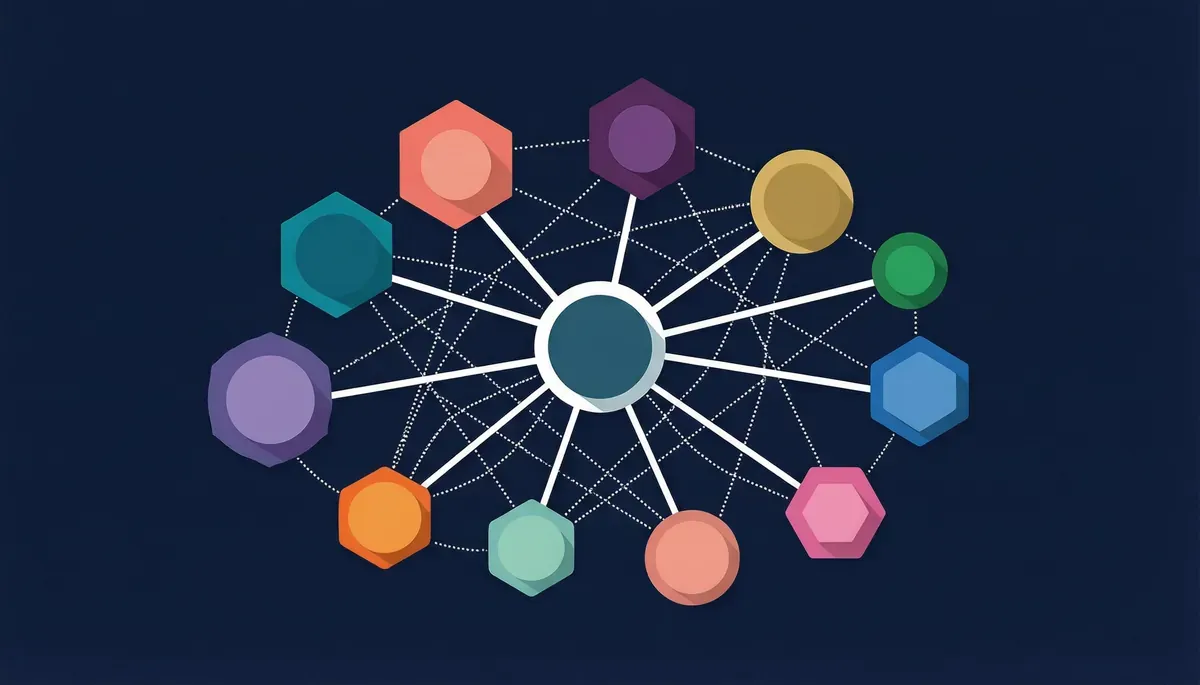
Responde a:What is the minimum viable architecture to operate with eleven AI models in production without depending on a single provider, maintaining quality and without blowing the budget?Media
Hipótesis:A viable multi-model orchestration architecture requires at least: a single command center, a documented failover matrix, non-interchangeable roles per model, and prompting rules that prevent the AI from inventing business rules.
Evidencia esperada:Stack Soberano operando con 11 modelos en producción desde el corredor Ambalá-Calambeo. Cada modelo tiene rol fijo documentado. Matriz de failover probada en 3 eventos de caída de proveedor durante 2025-2026. Prompting con reglas explícitas de negocio.
Planted:June 28, 2026
Last evolution:July 21, 2026

Abstract

Operating with a single AI model is convenient until that model fails, censors a task, or charges you three times for reasoning that another does just as well. This resource documents the orchestration architecture I use in production from the Ambalá-Calambeo corridor: eleven models with fixed roles, a failover matrix, and prompting rules that prevent the AI from inventing business rules. Useful for independent consultants, development teams, and anyone who wants to operate with AI without being held hostage by a single provider.

There was a specific moment when I stopped trusting a single model for everything. It was in mid-2026 when Anthropic temporarily disabled access to certain capabilities due to geopolitical restrictions. It wasn't the first time something like this happened with a provider — I had already seen it with OpenAI's policy changes and Gemini's API outages. But that time I was in the middle of a critical project, and the blockage left me without my main tool for hours.

Since then, I operate with what I call a Sovereign Stack: eleven models distributed by capability, with non-interchangeable roles, a documented replacement matrix, and a command center where knowledge does not reside within any model but in files that I control.

This document is the current version of that system. It is not theory — it is what runs in my consulting projects, automation with n8n, and development in Odoo.

The Principle That Organizes Everything: No Model Invents Business Rules

Before discussing which model does what, there is a rule that underpins the entire architecture: execution models do not make business decisions. They apply what is already documented.

The system has two levels:

  • Command Center — where the project's knowledge resides: requirements, business rules, regulations, data schemas. This knowledge exists in files that I control, exposed via MCP so that the execution models can read them without hallucinating.
  • Execution Arsenal — the models that act on that knowledge: planning, structuring data, generating code, debugging, refactoring.

If an execution model starts inventing logic that is not in the command center, there is a design problem in the prompt, not in the model.

The Command Center

NotebookLM via MCP — the static repository

It absorbs client PDFs, regulations, consulting minutes, diagrams. I expose it via MCP so that the execution models can read it in real-time. Its function is not to generate but to accurately recall what the client said or what the domain requires.

A clarification I learned the hard way: NotebookLM understands explicit context well but not implicit context. If a process manual assumes something without stating it, the model omits it. I always verify the extraction from MCP against the original document before using it as input for code.

Gemini / Tavily / Sonar — the explorer

For the zero phase of any project: tracking the state of the art, analyzing repositories, digesting dense technical documents or videos. The output of this phase goes directly to NotebookLM — not to the execution model.

What does not reach NotebookLM does not exist for the system. It is a restriction I imposed to prevent unvalidated context from contaminating the code.

The Tactical Arsenal — Eleven Models with Fixed Roles

The Architects

DeepSeek V4 Pro — deep reasoning, complex algorithms, Chain of Thought step by step. I use it when I need someone to think before executing: planning modules, resolving financial logic bugs, analyzing edge cases.

GLM-5.2 — relational structures, SQL schemas, JSON for APIs and n8n flows. It has a rigidity that in this context is a virtue: it does not improvise schemas, it defines them with normalization criteria.

The Executors

Kimi K2.7 Code — building from scratch, scaffolding, cohesion between multiple files. It is the main model of OpenCode when I start a new project.

Qwen 3.7 Max — complete refactorings of heavy modules. When a legacy file has 800 lines of technical debt, this is the model.

Qwen 3.7 Plus — the agile worker. Individual functions, unit tests, repetitive blocks. Fast and economical in tokens for well-defined tasks.

The Context and UI Specialists

MiniMax M3 — massive context window. I use it when I need to load the complete documentation of a new API or a 300-page manual directly into the prompt. It acts as a temporary knowledge base when NotebookLM is unavailable.

MiMo-V2.5-Pro — conversion of visual interfaces to frontend code. Sketch → Tailwind/React/Astro. It is the only model in the stack that receives images as the main input.

The Intervention Force

Claude Code CLI with Opus 4.8 — holistic understanding of systems. For bugs that cross from the frontend to the database or container configurations. It is not the first resource — it is the one I call when the other models do not find the root cause.

DeepSeek V4 Flash — almost zero latency for syntax fixes, missing dependencies, or micro-adjustments that the console throws. I pass it the raw error and the file; it repairs it in seconds.

Codex CLI — isolated execution of critical scripts before sending them to production. The system's sandbox.

Failover Matrix — How the System Doesn't Stop If a Model Fails

This table exists because it has served me. Not as an academic exercise.

If this model fails I use this instead Why it works
Gemini (research / vision) Opus 4.8 or MiMo-V2.5-Pro Opus has a broad knowledge base; MiMo analyzes diagrams and interfaces
NotebookLM / MCP (RAG) MiniMax M3 Massive context window — I inject the PDFs directly into the prompt
DeepSeek V4 Pro (logic) Opus 4.8 or Qwen 3.7 Max Qwen has solid mathematical reasoning; Opus excels in abstract deduction
GLM-5.2 (databases) DeepSeek V4 Pro Understands relational normalization and can design complex schemas
Kimi K2.7 Code (architecture) Qwen 3.7 Max Solid dependency management, generates folder and file structure consistently
Qwen 3.7 Plus (quick tasks) Kimi K2.6 Fast Low latency, economical, corrects TypeErrors almost immediately
MiMo-V2.5-Pro (visual UI) Qwen 3.7 Max or Gemini Gemini understands spatial layouts; Qwen implements it
DeepSeek V4 Flash (fixes) Kimi K2.6 or Qwen 3.7 Plus Both have low latency in OpenCode for console corrections

How the System Looks in a Real Project

New Module from Scratch

For an inventory management module or an analytical dashboard, the flow is:

  1. Gemini → NotebookLM: I extract business rules from the client, centralize in the MCP
  2. GLM-5.2: reads the context from the MCP and produces the schema.sql
  3. DeepSeek V4 Pro: builds the master plan in steps.md
  4. MiMo-V2.5-Pro: sketches the visual frontend if there is a draft
  5. Kimi K2.7 Code: executes the construction in OpenCode using the previous four steps as input

The construction model does not decide the architecture — it executes it. The architecture has already been defined in steps 1 to 4.

Complex Logic Bug

If the financial calculation yields negative under specific conditions and I don't understand why:

I open Opus 4.8 via Claude Code CLI. Prompt: "The net metric calculation is incorrect under these conditions. Analyze the mathematical logic, simulate the flow of variables, and correct the core function." I do not use DeepSeek Flash for this — speed does not help if the diagnosis is superficial.

Immediate Console Error

Syntax error, missing dependency, TypeScript that does not compile: DeepSeek V4 Flash in OpenCode. I pass it the error and the file. In less than a minute.

Refactoring Technical Debt

Qwen 3.7 Max with this unchanging prompt: "Refactor applying Clean Code principles, add strict typing, and document the functions. Do not alter the business logic under any circumstances." Before executing it, git commit -m "pre-refactor-AI". Always.

Three Orchestration Rules That Took Time to Learn

Atomic Iteration. Each task has a minimum executable scope. "Implement the user controller" → review → commit → "Connect the controller to the database." Requests like "give me the complete CRUD at once" generate predictable technical debt.

Context Minimalism. If I work on the backend, I close the frontend tabs in the editor. Loading unnecessary files in the chat window degrades the model's focus and wastes tokens. In OpenCode, this has a direct effect on the quality of the output.

Triangulation in Core Decisions. No change in the database or in the main calculation engine is executed without the approval of two models from different families. DeepSeek Pro for algorithmic logic + GLM to validate data integrity. The cost of an architectural error is orders of magnitude greater than the cost of a second opinion.

What Is Still Not Resolved

The system works well when the roles are clear. Where there is still friction: tasks that cross territories without a clean boundary — for example, when an ambiguous business rule requires both logical reasoning and understanding of the client's domain. In those cases, I still tend to use Opus 4.8 as an arbiter, which raises the cost. I am still evaluating whether DeepSeek V4 Pro can take on that role more consistently.

Also: the current version of the protocol does not have failover automation. If Gemini fails, I manually decide to use Opus. The next iteration of this resource will document whether it is worth automating that detection via n8n.

Tools and Stack in Production

Main CLI: OpenCode Active models in use: DeepSeek V4 Pro, DeepSeek V4 Flash, GLM-5.2, Kimi K2.7 Code, Kimi K2.6 Fast, Qwen 3.7 Max, Qwen 3.7 Plus, MiniMax M3, MiMo-V2.5-Pro Models via separate CLI: Claude Code CLI with Opus 4.8, Codex CLI Knowledge management: NotebookLM via MCP, .md files in version control Flow automation: self-hosted n8n Version control: Git with a policy of preventive commits before refactorings

Last updated: June 2026. If you are reading this at a later date and some of the mentioned models have already changed version or disappeared, the logic of roles and failover remains valid — just map the new equivalents.

Cited Sources

  • DeepSeek-AI. DeepSeek V4 — Technical Report. 2026.
  • Zhipu AI / Tsinghua University. GLM-5: Technical Report. 2026.
  • Moonshot AI. Kimi K2 — Technical Report. 2026.
  • Alibaba Cloud / Qwen Team. Qwen3 Technical Report. 2026.
  • MiniMax. MiniMax-M3 — Technical Overview. 2026.
  • Moonshot AI. MiMo-V2 — Vision-Language Model. 2026.
  • Anthropic. Claude Code CLI Documentation. docs.anthropic.com, 2026.
  • OpenAI. Codex CLI Documentation. 2026.
  • Anthropic. The Model Context Protocol (MCP) Specification. 2025.
  • Google. NotebookLM — AI-Powered Research Assistant. 2026.
  • n8n. Workflow Automation Platform — Self-hosted documentation. n8n.io
  • Odoo S.A.. Odoo ERP — Technical Documentation. odoo.com
  • Git. Distributed Version Control System. git-scm.com
  • Direct field evidence — Sovereign Hub, production stack, Ambalá-Calambeo corridor, June 2026.
The Cognitive Graph
Ramificaciones futuras

Preguntas abiertas del catálogo que este nodo toca o ayuda a responder. Click en una para ver todos los nodos del jardín que la exploran:

Urgent For a limited time

A "half-broken" piece of furniture or structure in your Airbnb costs 4× more in negative reviews than fixing it on time.

Design my structure →
Data Verified data

Projects with prior 3D modeling reduce manufacturing errors by 80% and material waste by 30%.

View technical cases →