Responde a:Will the 60 m Iwagé geodesic dome be classified as a lightweight or conventional structure by the competent authority?Alta
Hipótesis:The structural configuration will allow its classification as a lightweight structure.
Evidencia esperada:Concepto de curaduría, interpretación normativa y documentación técnica.
Responde a:Is the institutional familiarity barrier identified as a hypothesis confirmed in the actual curation process for the Iwagé geodesic dome?Alta
Hipótesis:Lack of familiarity with non-conventional construction systems influences the approval process.
Evidencia esperada:Actas, observaciones de la curaduría, tiempos del trámite y decisiones oficiales.
Responde a:Is the soil type and load-bearing capacity of the Ambalá–Calambeo corridor, which the dome's structural design assumed as starting assumptions, confirmed?Alta
Hipótesis:The geotechnical study will confirm that the planned structural design is viable for the terrain.
Evidencia esperada:Estudio geotécnico, ensayos de laboratorio y caracterización del suelo.
Planted:July 5, 2026
Last evolution:July 21, 2026

Abstract

A geodesic dome is not "a tent with a strange shape": it is a structure that distributes loads so efficiently that it can be supported with much lighter pieces than a conventional construction of the same volume —the bioclimatic and structural reasons behind this are developed in the sibling node of this piece. This node documents the V3 Kruschke classification system that we use in Espacios Plus to calculate domes: what those numbers mean, how geometry translates into a real cutting list, and why in the context of the Iwagé farm and the glamping market that same geometry is, besides honest engineering, a business decision backed by market data.

What "V3 Kruschke" means and why it is not unnecessary jargon

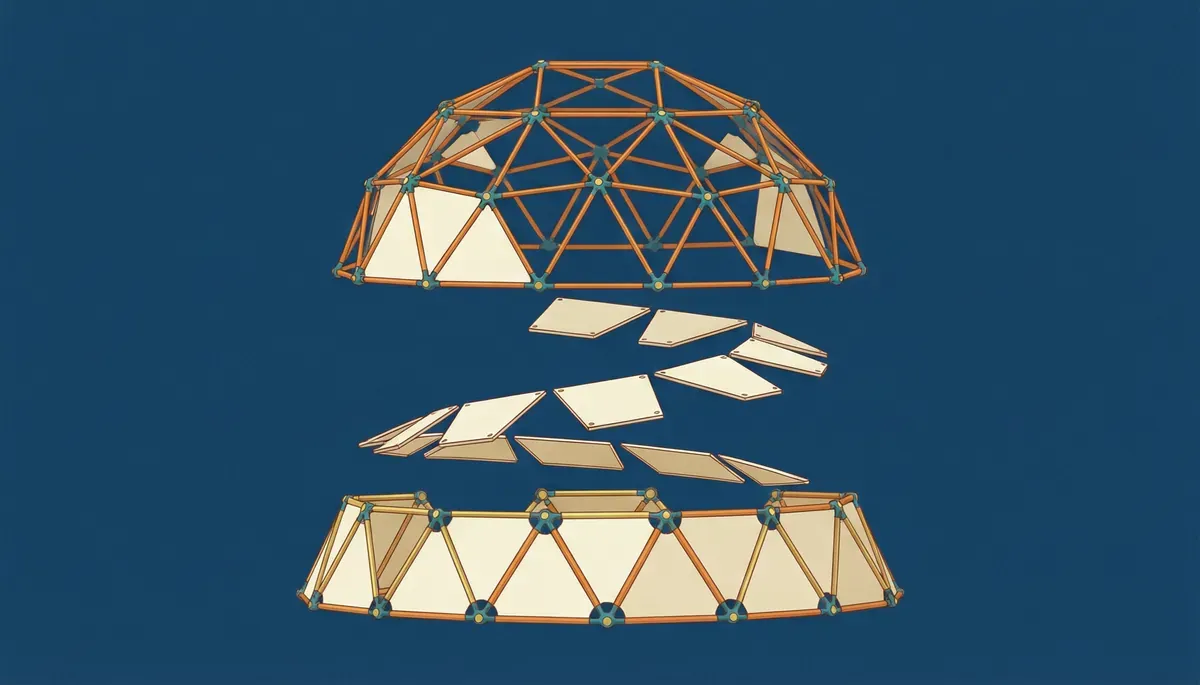
Analogy: imagine you want to cover a soccer ball with flat triangular patches, like a ball. The more patches you use, the closer the final shape gets to a perfect sphere —but you also need to cut more distinct pieces and calculate more angles. The "frequency" of a geodesic dome (the number that comes before the V, as in "3V") is exactly that: how many times you subdivided each original triangle of the base icosahedron before projecting it onto the sphere. A 3V dome has enough subdivisions to look rounded and be structurally efficient, without reaching the manufacturing complexity of a 4V or 5V —which multiply the number of distinct pieces without a proportional benefit for the size of the structure we normally build.

The Kruschke method comes into play when the frequency is odd (like 3V) and a flat base is needed instead of finishing the sphere at an irregular point halfway up. It is the technique that allows truncating the dome with a clean horizontal cut —the difference between a structure that stands well on the ground and one that needs improvisation at the base. The notation "5/9" or "5/8" that accompanies the Kruschke indicates what proportion of the complete sphere is being constructed: a 5/9 rises a little more than half of the sphere (tall profile, more interior volume, more sense of spaciousness), while a 3/8 stays lower (flattened profile, more efficient in wind but with less interior height).

How geometry translates into a real cutting list

A 3V 5/9 Kruschke dome does not use a single length of piece —it uses between 3 and 4 distinct lengths of "strut" (the linear structural element, whether tube, wood, or profile), each with its own cutting angle at the ends so that the faces fit exactly over the spherical curvature. A publicly documented case of a dome with a diameter of 7 meters and an interior height of 4.16 meters used 165 struts of 4 distinct lengths (30 of type A, 35 of type B, 80 of type C, 20 of type D), connected at 61 joint nodes of 3 distinct types depending on how many struts converge at each one (some 4-way, others 5, most 6). The material cost of that structure, not counting the covering, was just $883 dollars in galvanized steel pipe.

That level of detail —three or four lengths, three types of node, specific angles in each cut— is exactly what separates "I want to build a dome" from having an executable cutting plan. The floor area formula for a 5/9 Kruschke is 7.2222 × R² (where R is the radius of the complete sphere, not the radius of the floor), which allows calculating from the start how many usable square meters you will obtain before cutting the first piece —the same principle of "measure before building" that we already documented in the design node for small spaces, applied here to a geometry much less intuitive than a rectangle. This same precision in piece sizing is, by the way, the technical reason behind the material efficiency that the sibling node of this piece describes from the bioclimatic angle: not a piece more robust than necessary, nor one lighter than safe.

Why this geometry is also a business decision, not just engineering

In Colombia, glamping is growing at an estimated rate of 31% annually, with 30 to 40 new establishments opening each year —it went from 329 establishments registered with Cotelco in 2023 to 416 in 2024, with 1,584 rooms and 3,753 beds available that already exceed the capacity of traditional camps in the country. It is still only 0.53% of the total accommodation market according to the National Tourism Registry, but it is precisely that small size combined with that growth rate that reveals a category still to be consolidated, not a saturated niche.

Rates in Colombia range from $250,000 to $400,000 COP per night in mid-range options, $450,000 to $700,000 in premium glampings, and over $800,000 in exclusive experiences —figures that, as noted by an industry executive to Semana magazine, generate criticism because they equal or exceed the price of a conventional five-star hotel. And in construction, geodesic domes —one of the most common structures in the national glamping offer according to Portafolio— have a construction value ranging from $1.2 to $2.2 million pesos per square meter depending on materials, finishes, and size, which provides a reference for real and local cost, not just accommodation rate.

Commercial analogy: a dome within a Colombian glamping site functions the same as a honeymoon suite within a beach hotel —it is not the unit that fills the calendar, it is the unit that raises the average and attracts those looking for something memorable for a special occasion. Executives from Colombian glampings like Ensueño Glamp and Cumbre Glamp agree that the price is justified by an experience designed in detail for small groups, explicitly aimed at a middle to upper-class audience that values exclusivity over volume. That willingness to pay more for something geometrically different is precisely what turns the calculation of struts and angles into a revenue line, not just a technical precision exercise.

In the context of the peri-urban Iwagé farm, this connects directly with the main 60 m² geodesic dome already documented in the sibling node of the self-sustaining system: that same structure, initially conceived as a functional space within the productive system, is also the asset with the greatest potential for differentiation if the conscious nature tourism model incorporates accommodation —in a Colombian market that, according to industry spokespeople, still faces challenges of normalization and regulation, leaving real space for those who enter with a well-founded project from design and not just from aesthetics.

What the irreversibility of wood teaches this calculation

In the Rule of Three Axes, we documented that in manual craftsmanship there is no Control+Z: if you miscalculate the angle of a geodesic dome, the structure collapses. With Kruschke geometry, that principle becomes literal and mathematical —an error of a few degrees in the angle of a single type of strut, multiplied by the dozens of pieces of that same type that the structure carries, cannot be corrected by adjusting one piece: it forces you to recalculate and recut the entire series. It is exactly the type of restriction that, according to the pattern we have already confirmed across three territories of the portal, produces better design than the abundance of margin for error.

What is still unresolved

We do not yet have, at the time of writing this node, a constructed and operational Kruschke dome in the Ambalá-Calambeo corridor with real data on final cost, construction time, and —if it operates as an accommodation unit— market rate obtained. The geometric calculations and the reference case cited here are from publicly documented third parties, applied by extension to our context. The 60 m² dome of the Iwagé farm is designed and mapped in its regulatory process (NSR-10, Law 400 of 1997) but construction has not yet begun. This node will be updated with our own data on real cost and execution time as soon as the first dome is up —at the same time that the sibling node is updated with the real bioclimatic measurements of the same constructed dome.

Cited sources

  • ZipTieDomes.com / Domerama — technical specifications of 3V Kruschke calculators (4/9, 5/9, 5/8, 3/8) and floor area formula.
  • s k i v v i e's laser cut goodness (2020). Geodesic Dome Build: 7 meter diameter 3V 5/9 Kruschke Type — publicly documented case of real construction with material list and costs.
  • Jinco (2025). The rise of glamping in Colombia: a trend that redefines nature tourismCotelco data and National Tourism Registry (RNT), 31% annual growth.
  • Semana (2025-2026). How much does it cost to stay in a glamping in Colombia? — rate range $120,000-$1,000,000 COP and testimonies from the sector.
  • Glamping Colombia (2026). How much is a night in a glamping in Colombia worth? — rate segmentation by category, $250,000-$800,000+ COP.
  • Portafolio (2025). Hotels in nature, in the spectrum of tourist offerings — construction value of geodesic domes in Colombia, $1.2-$2.2 million COP per m².
  • La República (2025). Glamping in Colombia leads the tourism, ecotourism, and accommodation segment — presence in 11 departments of the country.
  • Wilderness Resource / Hypedome (2025-2026). How to Start a Glamping Business — daily rate ranges by type of structure ($100-300 tents vs. $200-500+ domes).
The Cognitive Graph
Ramificaciones futuras

Preguntas abiertas del catálogo que este nodo toca o ayuda a responder. Click en una para ver todos los nodos del jardín que la exploran:

Urgent For a limited time

A "half-broken" piece of furniture or structure in your Airbnb costs 4× more in negative reviews than fixing it on time.

Design my structure →
Data Verified data

Projects with prior 3D modeling reduce manufacturing errors by 80% and material waste by 30%.

View technical cases →