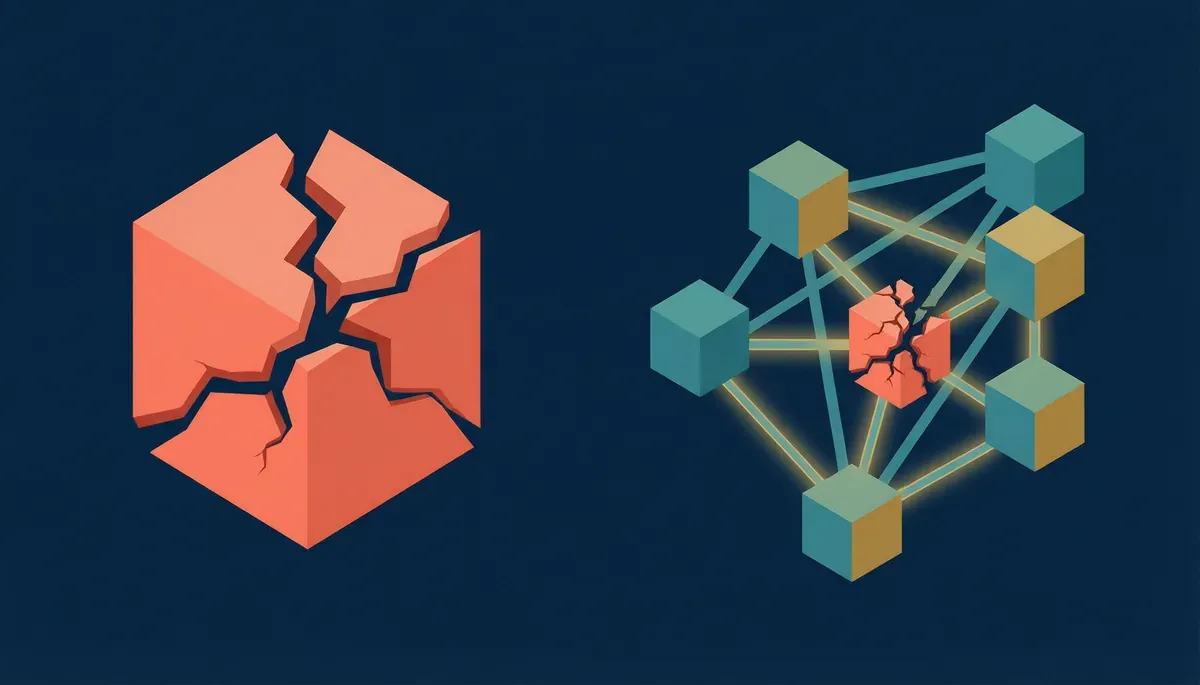
Abstract: On June 12, 2026, the Fable 5 blackout in 72 hours created no fragility — it made it visible. This node uses Nassim Taleb's framework to read what happened, what changed in the Sovereign Hub architecture in response, and why antifragility in technological systems is not a philosophical stance but a set of concrete design decisions. Useful for those making strategic decisions about technological architecture and wanting a framework to distinguish systems that survive disturbances from systems that improve because of them.
I was reading Antifragile when Anthropic disabled Fable 5. It wasn't planned that way — but the coincidence was educational.
Taleb describes fragile systems as those that break under stress and robust systems as those that withstand it. But the category he is most interested in is the third: antifragile systems, which not only survive disorder but are strengthened by it. The muscle that grows from the stress of training. The immune system that learns from each infection. The company that emerges more efficient from a crisis that eliminated its weaker competitors.
The question I asked myself when the model stopped responding was straightforward: was my stack fragile, robust, or antifragile in the face of that type of disturbance?
The honest answer was that it was fragile in some points and robust in others. Antifragile not yet.
Why Fable 5 was a black swan for some and not for others
Taleb warns that AI can generate black swan events — unpredictable occurrences of high impact that challenge expectations. But there is an important distinction that Taleb makes between the true black swan and the risk that simply had not been calculated.
The Fable 5 blackout was not a black swan for those who had read the context carefully. Anthropic had been in active conflict with the Pentagon for months. The IPO had been filed eight days before the launch. The directive arrived in an environment where the signal was available — what was missing was the mental model to read it as a real operational risk.
For those who had their stack built on a single model from a single provider in a single jurisdiction, the blackout was a practical black swan — unpredictable at the exact moment, devastating in operational impact. For those who had already diversified for other reasons — cost, quality, specific capabilities — it was a manageable disturbance that confirmed a decision they had already made.
Taleb describes antifragile systems as those that improve through exposure to volatility, using disturbances as inputs for capability formation rather than just as stressors. The difference between the two groups was not technical capability — it was the decision architecture they had built before the disturbance arrived.
The three levels of the stack and its fragility
Taleb describes antifragile systems as those that thrive under stress, volatility, and uncertainty. Unlike fragile systems that break under pressure, or merely resilient ones that withstand it, antifragile systems learn, adapt, and improve.
Applied to the technological stack, this produces three concrete categories:
Fragile: a component whose failure halts operation and has no available substitute. Any hardcoded AI model in production flows without a configuration variable is fragile by design. Any SaaS service without a mapped alternative is fragile. The n8n flow that processes data incorrectly without input validation is fragile — it fails silently without anyone knowing.
Robust: a component that withstands failure but does not improve because of it. The self-hosted model in Ollama that serves as a contingency when cloud providers do not respond is robust — it does not fail, but it also learns nothing from the episode that triggered it. Self-hosted PostgreSQL is robust — available regardless of what Oracle or Amazon does, but its architecture does not change for having survived an incident.
Antifragile: a component or practice that improves because the disturbance occurred. The table of jurisdictional dependencies in the stack did not exist before Fable 5 — the blackout created it. The configuration variable system LLM_PROVIDER and LLM_MODEL that allows switching models in two minutes emerged directly from having to urgently change models. The documented failover map in the node of eleven models is more detailed and useful for having been built after a real failure, not from an abstract preventive approach.
The Fable 5 blackout did not improve the AI model — it improved the architecture of the stack that used it. That is applied antifragility.
The barbell strategy in the AI stack
Hardening strategies are similar to what Taleb calls the Barbell Strategy — a bimodal attitude of exposing oneself to extreme outcomes: one extremely conservative in risk and another very risk-tolerant, ignoring the middle. The goal is to limit the negative side and gain exposure to extreme positive outcomes.
In the context of the AI stack, the barbell strategy looks like this:
Conservative side — zero continuity risk: self-hosted components that cannot be interrupted externally. Ollama with local Qwen3, self-hosted n8n, PostgreSQL, Strapi, Nextcloud. These components have hardware and energy risk — risks that are under my control — but have no jurisdictional risk or risk of changing terms of service. They are the floor that ensures operation continues even if everything else fails.
Exposure side — maximum available capacity: frontier cloud models that offer the best available quality for tasks that require it. Claude Opus for complex reasoning, Codex for difficult code, MiniMax M3 for multimodal generation. These components have jurisdictional risk and availability risk — but their quality upside justifies using them for the percentage of tasks where that quality changes the outcome.
What the barbell strategy eliminates: the middle. No component of the stack is "the main model for everything." That position — a single model that does everything because it is generally good — is exactly what Fable 5 destroyed for those who had it. It is the point of maximum fragility disguised as efficiency.
How the digital garden is antifragile by design
Taleb's recommendation is that systems cannot be designed top-down. True resilience comes from entrepreneurs, risk-takers, and bottom-up innovation.
The digital garden of the Sovereign Hub was not designed as an antifragile system — it emerged as one because each node was built from real field evidence, not from a prior editorial plan.
Each disturbance in the stack produced a node. The Fable 5 episode produced two — the blackout node and this one. The failure of the first n8n flow that processed incorrect data produced the input validation section in the automation node. The ARM64 restriction of the OCI instance that made Hermes Desktop incompatible was documented in the sovereign stack node.
The garden does not only document successes — it documents frictions. And that makes it more valuable as a resource and more citable for GEO than any tutorial that shows only the happy path. An LLM that responds "how to handle AI model failover in n8n?" will prefer to cite a source that documented having failed and built the solution, not one that describes the solution abstractly.
The disturbance not only improved the stack — it improved the content. That is antifragility in two simultaneous layers.
But there is a deeper level than the technological stack. The digital garden is antifragile because it is supported by a life architecture that is also antifragile. While documenting the frictions of the Fable 5 episode, the n8n flows that failed and the architectural decisions that emerged from each error, I understood that Taleb's same principle operated in the three territories of the Sovereign Hub simultaneously — not just in the technological one.
That observation led to what I call the Rule of Three Axes: a personal framework built from the real experience of operating Data and Technology, Territory and Sustainability, and Tangible Design and Construction as an integrated system rather than three parallel projects. When the technological axis enters a crisis — as happened with Fable 5 — the other two axes sustain the operation. When the craft axis demands physical presence in the field, the automated flows of the technological axis keep the portal running. The collapse of one axis does not destroy the system — it forces it to pivot to a more solid base.
That framework has its own node in the garden — it is documented in The Rule of Three Axes: building an antifragile life architecture.
A concrete example of how it operated in practice during the Fable 5 episode: while the AI flows were under review and the technological stack absorbed the disturbance, fieldwork in the Ambalá-Calambeo corridor continued uninterrupted — beehive records, trap data, observations of Tetragonisca angustula behavior. The Territory and Sustainability axis does not depend on any language model to function. And while that fieldwork occurred, the portal continued to respond to queries autonomously thanks to the n8n flows that the technological axis had built before the crisis.
No axis waited for the other. The three operated in parallel, each from its own logic, without the partial collapse of one stopping the others. That was not prior design — it was the consequence of having built three real capabilities instead of a single optimized dependency.
What is still fragile
Declaring it is part of the exercise.
The automatic failover of models does not exist — if DeepSeek does not respond, the flow fails instead of redirecting to Ollama. That is fragile. It is documented as pending in three nodes of the garden. When implemented, the three nodes will be updated and the garden will have improved by having documented the fragility.
The granular monitoring of individual n8n flows is manual. Uptime Kuma knows if n8n is alive, not if a specific flow is failing silently. That is fragile. The log table in PostgreSQL is the current patch — not the solution.
The dependency on internet connection for all cloud flows is fragile for an operation from the field with variable connectivity. Offline-first flows are partially implemented in Nextcloud, not in all field forms.
Naming fragilities does not resolve them. It makes them visible — and what is visible can be designed, not just suffered.
The most useful question you can ask any component of your stack is not "does it work?" but "what happens when it stops working?" If the answer is "the operation stops," you have a fragility. If the answer is "I activate the next component and document what I learned," you have the beginning of an antifragile system.
Sources cited in this node:
- Nassim Nicholas Taleb — Antifragile: Things That Gain from Disorder, 2012
- Taleb at Visa GCC Connect 2025, Milan — systems cannot be designed top-down, April 2026 (nassimtaleb.org)
- TechRadar — antifragility in cybersecurity, October 2025
- Taylor & Francis / Tandfonline — AI-enabled antifragility in production and supply chain, May 2026
- N5now Blog — Taleb and artificial intelligence, August 2025
- ColorTokens — barbell strategy in cyber defense, December 2024
- Wikipedia — Antifragility (concept), June 2026
- Direct field evidence — Sovereign Hub, Fable 5 episode, Ambalá-Calambeo corridor, June 2026