Abstract
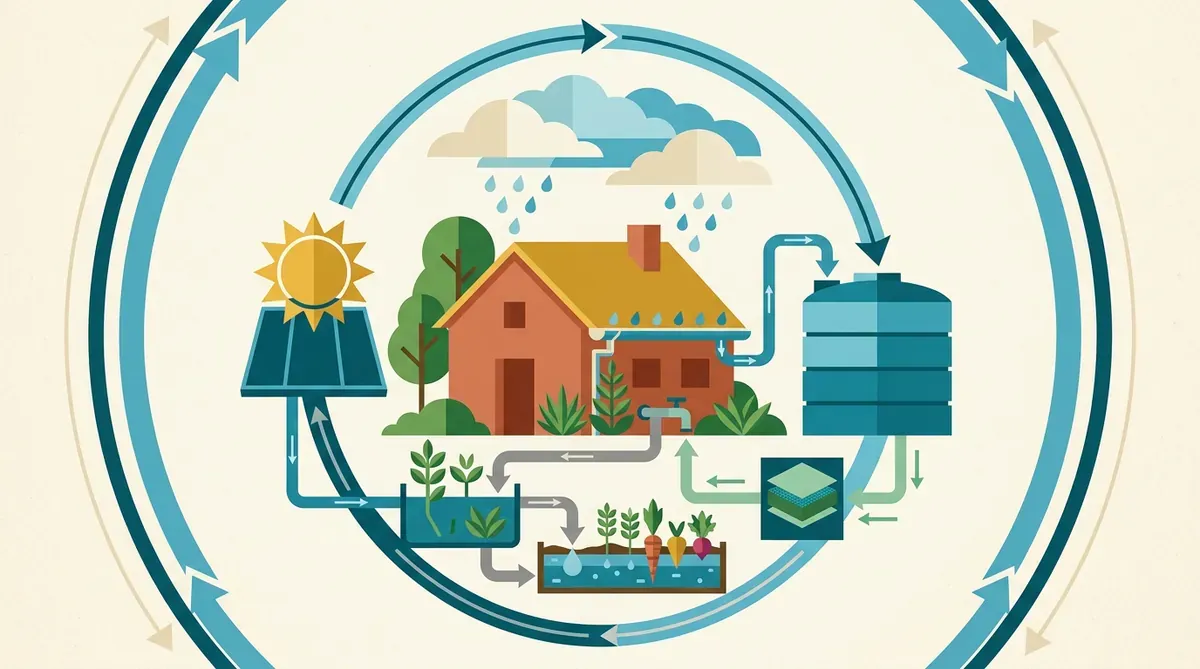
The anchor node of the self-sustaining system mentioned three components of the water subsystem: rainwater harvesting with a capacity of 40,000 liters annually, recirculation of gray water under Resolution 1256 of 2021, and the dry toilet already developed in the bio-refinery node. This node closes the complete circle: how real capture is sized, what the Colombian regulation says exactly about reusing water, what domestic habit change—not just plumbing—makes it possible for that cycle to work, how the sun itself enters the system as a heater and disinfectant, and why the legal distinction between "recirculating" and "reusing" determines whether a project needs prior environmental processing or can operate without it.
The analogy that explains why this is a closed loop and not three loose solutions
Analogy: a conventional water system is like a river that only flows in one direction—the water enters from the public network, is used once, and exits to a sewer system that never sees it again. A closed-loop system is more like the circulatory system of a body: the same water goes through multiple uses before leaving the system, each one taking advantage of what the previous one left available. The rainwater captured by the roof supplies consumption and irrigation; the gray water from showers and sinks, treated, returns to irrigation; and what can no longer be reused as water, in the case of the dry toilet, doesn't even become wastewater—it directly turns into compost, as we have already documented in the bio-refinery node.
Piece 1 — Rainwater harvesting: a simple formula that is rarely applied rigorously
The sizing principle is simpler than most guides make it seem: each square meter of roof surface captures approximately 1 liter of water for every millimeter of precipitation. With that, the real calculation requires two data points that do require serious research: the average monthly precipitation of the specific area, ideally based on records of at least 10 to 15 years, and the actual consumption demand—not the aspirational—of those who will use that water.
As a reference for domestic consumption, a widely used standard in the region calculates around 135 liters of water per person per day for basic consumption. For the 60 m² dome of the Iwagé farm, that means that its own roof—without counting any other capture surface—is an active piece of the water system: each millimeter of rain over those 60 m² represents 60 liters of potentially usable water.
The projected capacity of 40,000 liters annually, already mentioned in the anchor node, is the result of multiplying the available roof surface in the set of structures of the farm by the average precipitation of the Ambalá-Calambeo corridor. What has not yet been done is to verify that figure against actual rainfall data from at least a decade for the specific corridor, instead of a generic departmental average.
Piece 2 — The habit change that no plumbing can solve on its own
Before any legal or technical consideration, there is a prerequisite that determines whether the gray water system works or simply fills with unusable water: what is thrown down the drain. Plants watered with biodegradable detergents not only stay healthy—in comparative tests, they outperformed control plants watered with conventional tap water because eco-friendly soaps effectively act as light fertilizers. The problem is not "any conventional soap" in general, but three specific components: sodium, chlorine, and phosphates. Detergents with sodium can inhibit seed germination and destroy soil structure by dispersing clay; chlorine is toxic to microbial life and plants; and phosphates, although in minimal doses act as nutrients, in excess imbalance the soil.
Analogy: it is exactly the same type of restriction that we have already documented for the dry toilet in the bio-refinery node—it is not a technical limitation of the system, it is a change in domestic habit that the system requires to function. Changing dish detergent or bath soap for a version without sodium or phosphates is not an aesthetic sacrifice of "sustainable living"—it is literally the inlet valve that decides whether the water that comes out of the shower is a resource for irrigation or a threat to the soil intended to be watered with it.
This connects with the same cultural pattern already named in the dry toilet node and in the tiny house node: technology is rarely the real obstacle. Here the obstacle is even simpler—it is a shopping habit in the supermarket, sustained throughout life, that must be consciously changed without exceptions for the rest of the engineering to make sense.
Piece 3 — The sun as a heater and as a disinfectant, without spending a watt of the solar system
The energy subsystem of the farm, already documented in the off-grid solar system node, sizes photovoltaic energy for automation, lighting, and equipment—but heating and disinfecting water with that same electrical energy would be a waste because the sun can do both directly, without going through a panel or a battery.
Direct solar heating: a simple solar thermal collector—often a dark coil exposed to the sun inside an insulated box—heats water for domestic use without consuming a single watt of the photovoltaic capacity already reserved for sensors, automated irrigation, and the rest of the farm's automation. It is the same efficiency logic that we have already applied in the geodesic dome: using the available physical property—in that case, geometry; here, radiation—rather than wasting generated energy to solve what the environment already solves for free.
Solar disinfection (SODIS): for drinking water that requires additional microbiological assurance beyond simple rainwater capture, the SODIS method—exposing water in transparent containers to UV-A solar radiation for 6 to 48 hours—is a technology specifically validated in Colombia: a study with raw water from the Sinú River, using the meteorological station of the University of Sucre, managed to eliminate all coliforms from the samples after 18 accumulated hours of radiation, also reducing the initial turbidity of the water by 43%. For additional thermal pasteurization, dark-colored containers can raise the water temperature to 65-70°C, enough to inactivate most pathogenic microorganisms without the need to boil the water.
The method has limits that must be declared without embellishments: it does not work well during continuous rain or completely cloudy days, when the intensity of UV-A radiation drops to a third of that recorded on a clear day, and it does not eliminate chemical contaminants such as arsenic, fluoride, or agricultural residues—only biological pathogens. For the Iwagé farm, whose source water is primarily captured rain and not a river with possible agro-industrial contamination upstream, that specific limit is less relevant than in the case of the Sinú River, but it remains the reason why SODIS complements, and does not replace, other water quality controls.
Piece 4 — Recirculating is not the same as reusing, and the difference matters legally
Here is the technical nuance that most popular articles on "reuse of gray water" oversimplify: Resolution 1256 of 2021 from the Ministry of Environment distinguishes two legally distinct categories.
Recirculation is the use of wastewater in operations within the same economic activity that generated it, as long as it does not come into contact with the soil. For this category, the regulation is explicit: as long as it is technically and economically viable, any user can recirculate their wastewater without requiring prior environmental authorization.
Reusing, on the other hand, is the use of that water in an activity different from the one that generated it—for example, using gray water from the dome's showers for irrigation of the agroecosystem. This category does require obtaining a wastewater concession from the competent environmental authority in advance.
For the Iwagé farm, that distinction directly determines the processing: if the treated gray water is used within the same irrigation system that is already part of the integrated agricultural operation, it probably qualifies as recirculation. If it is intended for a clearly different use, it probably requires the reuse processing with its respective concession. It is the same type of early classification decision that we have already documented for the dome under NSR-10: correctly defining the category from the initial design, not after the environmental authority objects to it.
It is worth being honest about a real technical criticism: a professor from the Piloto University warned that, unlike the previous 2014 resolution, Resolution 1256 of 2021 adheres to less specific microbiological parameters, leaving out the search for certain potentially harmful bacteria. That does not invalidate the regulation or the project—but it means that a well-designed system, especially if the final destination includes contact with crops for human consumption, should exceed the minimum legal requirements, not limit itself to them.
How this connects with the rest of the bio-refinery
Water is not an isolated subsystem—it is the vehicle that connects the other two already documented in the bio-refinery node. The biodigester needs water in a 1:1 ratio with manure or organic waste to function. The dry toilet exists precisely to reduce the need for water in sanitation, freeing it for other uses in the cycle. And the treated gray water, once it completes its recirculation or reuse cycle, can end up irrigating exactly the crops whose residues feed both the biodigester and the Black Soldier Fly.
This is, in practice, the interdependence of subsystems that the anchor node named abstractly: the biodigester affects the composition of the soil that affects the crops that affect biodiversity that affects the beehives. Water is the flow that literally passes through each of those links—and the sun, at no additional cost to the energy system, heats and disinfects much of that flow before it needs any other intervention.
What is still unresolved
The capture capacity of 40,000 liters annually remains a projection based on departmental averages, not on rainfall data specifically verified for the Ambalá-Calambeo corridor over at least a decade. The gray water recirculation system is conceptually designed, but the exact legal classification—recirculation versus reuse—has not yet been formalized with the corresponding environmental authority. There is also still no written protocol for which specific cleaning products will be used on the farm to ensure compatibility with the gray water system, nor a solar thermal heater or a SODIS disinfection point installed and tested under the actual cloudiness conditions of the corridor.
Cited sources
- Resolution 1256 of 2021, Ministry of Environment and Sustainable Development of Colombia—distinction between recirculation and reuse.
- Hanna Instruments Colombia (2025). Regulate the use of wastewater in Colombia—technical criticism by William Antonio Lozano, Piloto University.
- Rotoplas Central America (2019-2025). Know the capacity of Rotoplas tanks—standard of 135 liters per person per day and capture formula per millimeter of rain.
- Wikipedia / Appropedia (2025-2026). Gray water—restriction of sodium, chlorine, and phosphates in detergents for safe irrigation with gray water.
- Hogar.98905.com (2025). What happens to the plant if watered with detergent?—comparison of plants watered with biodegradable detergent outperforming the control group.
- Revista Espacios (2020). Disinfection of raw water with solar radiation (SODIS)—real case Sinú River, University of Sucre, elimination of coliforms after 18 hours of radiation.
- EAWAG/SANDEC—Emergency WASH (2024). H.12 Solar disinfection (SODIS)—pasteurization temperature, limits on cloudy days, contaminants not eliminated.
- iAgua (2017). Solar disinfection and evaluation of thermal contribution.
Preguntas abiertas del catálogo que este nodo toca o ayuda a responder. Click en una para ver todos los nodos del jardín que la exploran:
- ¿Los 40.000 litros anuales estimados de captación de lluvia se confirman con datos pluviométricos reales del corredor Ambalá-Calambeo durante el primer año de medición en campo?La estimación de captación coincide con los registros climáticos históricos de la zona.