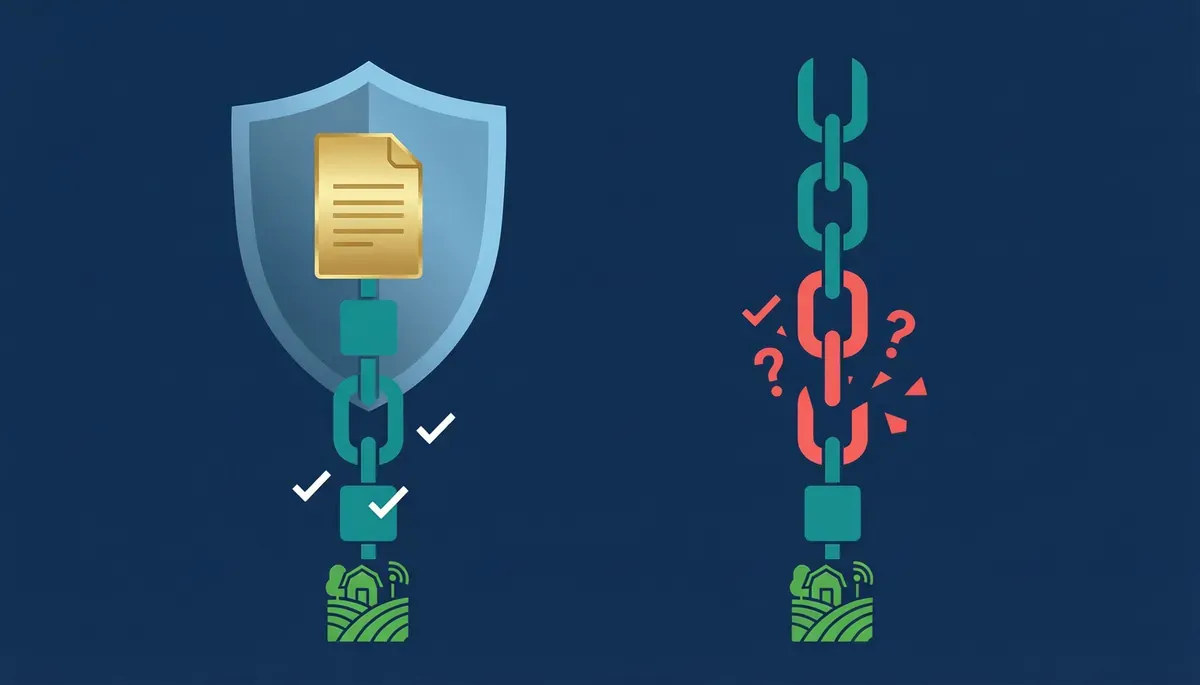
Responde a:How to distinguish a legitimate sustainability claim from greenwashing using data traceability back to the source sensor?Media
Hipótesis:Research question. Area: Territory and Sustainability.
Planted:July 1, 2026
Last evolution:July 21, 2026
Reason for evolution:Parte de: Iwagé — Sistema Autosustentable

Abstract

Three distinct nodes in this series —peri-urban farm, meliponary, self-sustaining anchor system— left the same issue pending: integrating field data into Sostenty's ESG system to produce auditable metrics. This node closes that gap by explaining what is truly required for an ESG report that withstands scrutiny in 2026, why traceability to the original data —not the eloquence of the discourse— is the only thing that distinguishes legitimate sustainability communication from another case of greenwashing, and how the Sovereign Hub already has, unknowingly, much of that traceability built.

The analogy that explains why 2026 changed the rules of the game

Analogy: until a few years ago, declaring that a project was "sustainable" worked like an unsupported invoice — the number appeared, no one asked where it came from, and it was accepted in good faith. The European Directive 2024/825, with mandatory transposition before March 2026 and application from September of that year, changes that invoice for one that requires the original receipt attached: every environmental claim must be backed by verifiable data and, in many cases, independent certification. It is not an isolated European requirement — it is the global direction. In Colombia, there is still no identical directive, but the regulatory and market pattern is already underway: consumers and investors demand proof, not discourse.

The numbers that explain why distrust is the starting point, not the exception

Only 34% of Latin Americans believe that companies tell the truth about their environmental impact, according to Edelman 2025. And it is not a perception without foundation: between 2020 and 2023, Indecopi detected 807 potential cases of misleading green advertising just in Peru, and preliminary investigations for 2025 already exceed 1,400. Recent high-profile cases are not small actors without legal resources — they are Shein, fined 40 million euros in France in 2025 for unjustified environmental claims; KLM, condemned in 2024 for its "Fly Responsibly" campaign; and Lufthansa, whose CO2 compensation advertising was banned in 2025. If companies with complete legal departments and compliance budgets could not sustain their claims under scrutiny, the lesson for a project the size of Iwagé is not "this won't happen to me" — it is that the requirement for traceability is not optional or proportional to the size of the project.

What is truly required for an ESG report that withstands scrutiny, beyond the word "sustainable"

The new European directive, although it does not directly apply in Colombia, is useful as a reference standard because it precisely defines what makes an environmental claim defensible: it prohibits generic claims like "ecological" or "green" without specific proof, prohibits declaring climate neutrality based solely on emission compensation without real reduction, bans any sustainability label that does not come from a recognized and verified certification system, and requires that any claim about future results be supported by public, measurable commitments that are independently verified.

Applied to the language we already use in this series about Iwagé, this means a very concrete distinction: saying "we reduced water consumption on the farm" without more is exactly the type of generic claim that the directive prohibits. Saying "the ESP32 sensor system documented in the rural edge computing node records a measurable 30% reduction in irrigation water consumption, verifiable in the soil moisture records captured from a specific date" is the same assertion, but with the traceability that distinguishes it from an empty claim. The difference is not in the message — it is that every word of the second can be traced back to a specific source data, with date and source.

The three patterns of greenwashing that this series has already avoided, without explicitly intending to

Greenwashing analyses in 2025 identify recurring patterns that are worth naming because, reviewing the entire garden, Iwagé has already dodged them due to the editorial discipline applied since the beginning of the series — not by chance. The pattern of "isolated green projects" —highlighting a specific action and omitting greater negative impacts— is exactly the opposite of what the anchor node of the self-sustaining system does, which explicitly states what is operational, what is designed but not built, and what has not yet been measured. The pattern of "label without proof" —using the word sustainable without metrics or scope— is the opposite of the already established practice throughout the series of citing figures with source, range, and declared limitation, such as the 25-40% biological retention rate of the meliponary or the 8.33% capture effectiveness documented in the field notebook. And the pattern of climate neutrality based solely on compensation, without real reduction, does not apply because Iwagé has not made that claim in any node — and this node explicitly states it as a commitment, not as an accidental omission.

How the pending integration with Sostenty looks in practice

The international reference standards for ESG reporting —GRI, CSRD, TCFD— agree on a structural requirement that ESG management platforms are designed to automate: centralize and verify data, not just narrate the result. For Iwagé, this means that the integration with Sostenty, mentioned as pending in three distinct nodes of this series, is not a task of "connecting an API" — it is building the bridge between the existing data (the field notebook record, the readings from the ESP32 sensors, the consumption data from the solar system) and a reporting format that a third party can audit without relying on the project's own word.

Analogy: it is the difference between telling a bank how much money you have and showing them the bank statement. The former is an assertion; the latter is evidence that the bank can independently verify against its own records. Sostenty, in this analogy, is the system that converts the raw data already generated by the meliponary and field sensors into something with the same level of verifiability as a bank statement — not because the project declares it, but because the data itself is available for anyone who wants to confirm it.

What is still unresolved

The technical integration between Iwagé's field data and Sostenty has yet to be built — this node does not resolve that pending task, it only frames it with the standard that it should meet when constructed. There is still no formal protocol for what specific claims about Iwagé will be communicated publicly and with what level of evidence backing them, beyond what this series of nodes has already documented in a scattered manner. And Colombia, unlike the European Union, still does not have a directive equivalent to 2024/825 that legally mandates this traceability — which means that applying it here is, for now, a decision of self-discipline, not a local regulatory requirement. That is perhaps the most important point of this node: doing it right not because Colombian law requires it yet, but because the documented distrust of the majority of Latin Americans who do not believe in companies' environmental claims is already reason enough.

Cited sources

The Cognitive Graph
Ramificaciones futuras

Preguntas abiertas del catálogo que este nodo toca o ayuda a responder. Click en una para ver todos los nodos del jardín que la exploran:

Urgent For a limited time

A "half-broken" piece of furniture or structure in your Airbnb costs 4× more in negative reviews than fixing it on time.

Design my structure →
Data Verified data

Projects with prior 3D modeling reduce manufacturing errors by 80% and material waste by 30%.

View technical cases →