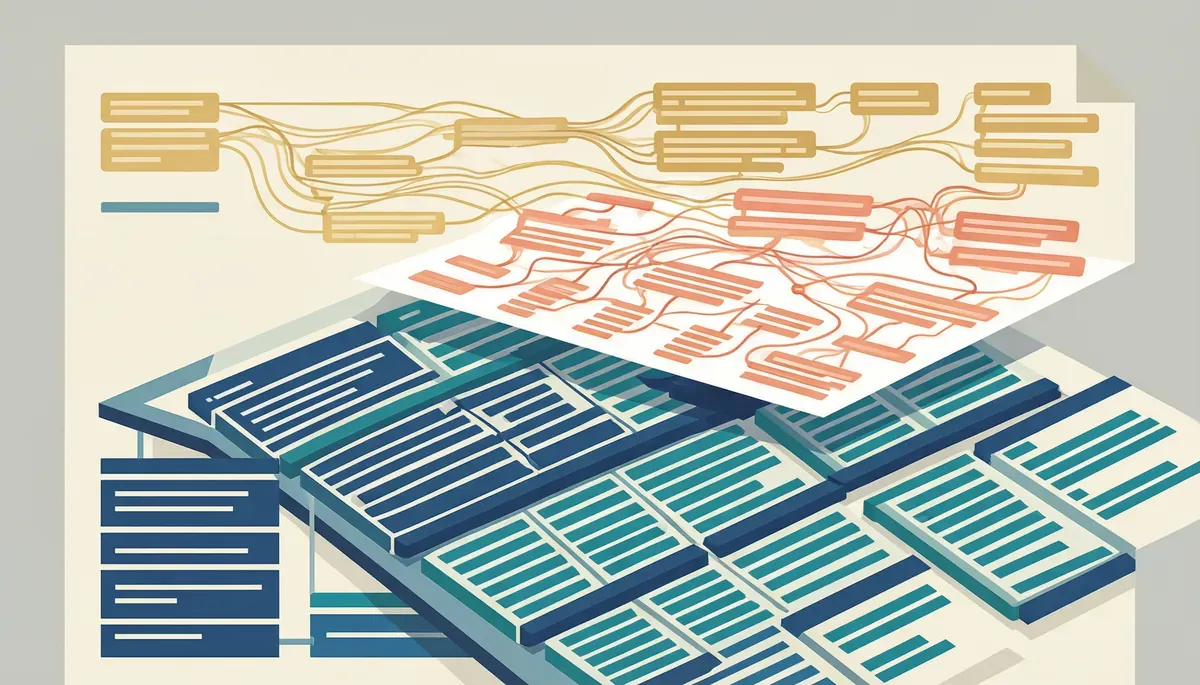
Responde a:How do the organic layer (links born from writing) and the structural layer (metadata declared in headers) coexist in a knowledge graph that an LLM can query with discernment — without falling into the chaos of a shapeless network or the rigidity of a database disguised as a garden?Media
Hipótesis:Research question. Area: Data and Technology.
Planted:June 17, 2026
Last evolution:July 21, 2026

Abstract

As of this node's date, the Sovereign Hub graph contains 44 nodes, 123 concepts, and 882 typed relationships — plus a fifth territory, silent for the visitor, that documents how the system thinks about itself. That volume is not sustained solely by intuitive links or rigid metadata. This node documents the two layers that support it: the organic layer that arises in the body of the text as I write, and the structural layer declared in the header of each note. Neither of the two alone sustains a system that a language model can query with criteria — and I learned that by building it, not by reading it, with real data from the graph to date, not with a projection of how it should look.

The problem that arises when the garden no longer fits in memory

With ten notes, any linking system works — human memory is still sufficient to remember where everything is. The problem appeared after the twentieth note: I began to find the same concept written twice with different names, and links that connected ideas by free association but that no filter or automated query could distinguish by type, state, or territory. With 44 nodes and 123 active concepts today, that problem can no longer be solved by 'remembering better' — it is solved with structure, or it is not solved. A hyperconnected graph without structure is as useless for precise querying as a rigid database without space for free association — both extremes fail, each in its own way.

The solution was not to choose one of the two layers. It was to design both so that they did different jobs and supported each other.

Why this is not just personal organization — it is the architecture that companies are adopting now

The enterprise knowledge graph market was valued at $3.5 billion in 2026, with a projected compound annual growth rate of 21% until 2035 (EconMarketResearch, 2026). The reason: it is expected that by 2026, 85% of companies will adopt hybrid RAG systems that combine vector and graph databases, precisely because a RAG that only searches by text similarity fails in questions that require connecting information between different documents (Neo4j / Newline analysis, 2026).

The data that made me take the design of these two layers seriously was another: 67% of enterprise knowledge graph projects that are abandoned cite the lack of internal expertise in graphs as the main cause — ahead of budget or vendor issues (survey of business data leaders, 2025). The graph does not fail due to a bad idea. It fails because no one designed with enough discipline what layer does what job.

The organic layer: what I connect while I write

The links I put within the body of a node — to another node, to a source, to a concept that already exists in the graph — arise at the exact moment of drafting, not later in an 'organization' session. When I wrote the node about phase financing of Iwagé and linked the Rule of Three Axes, that connection was not planned in advance — it appeared because, when explaining why each phase self-finances with the previous one, the logic of 'work with what you have' was literally the same idea applied to money instead of energy or data.

That is the horizontal layer: it jumps from territory to territory (from Territory and Sustainability to Identity and Purpose, in that example) following the real association of the idea, not a predefined hierarchy. In the actual graph scheme of the Sovereign Hub (SC-HS v2.0), these links are typified as relationships — not as free text, but as one of eight closed relationships, and to date with a very uneven distribution among them: sustains (314 instances), applies_in (192), derives_from (150), classifies_as (101), supported_by (78), contributes_to (42), based_on (4) and replaces (1). Closing the vocabulary of relationships was a deliberate decision: a link that simply says 'related to' is of no use to anyone who wants to ask the graph what evidence supports this concept, or which decision replaced which. That sustains concentrates more than a third of the total 882 relationships is not a flaw — it is the footprint of a portal where most claims are supported by field evidence, not by loose declaration.

The structural layer: what I declare in the header of each note

The header of each node — territory, audience, format, maturity state — does not arise from writing. It is decided before writing, and that is why it imposes the rigorous order that the organic layer cannot give itself. It is the difference between being able to ask the system 'show me all nodes in 🌱 seed state of the territory Data and Technology' and having to read 30 complete nodes to find the answer.

In the actual portal scheme, this layer is not limited to 'type of note'. The graph works with seven types of entities — Territory, Theme, Concept, Question, Content, Decision, Evidence — and each published node is processed to extract which of those entities it introduces or reuses. The maturity state (🌱 Seed · 🌿 Growing · 🌳 Mature) is not a decorative label: it determines, among other things, whether a concept is still treated as a hypothesis or if it already has enough accumulated field evidence to be confidently cited in another node.

Where the first version of this scheme failed

The initial version (v1.0) of the scheme had gaps that only appeared with use: a finding recorded during the extraction process (H-003) documents that a derives_from relationship was missing between the concept of 'citable claim' and the node from which it actually originated — an omission that only became visible when auditing the complete graph, not when designing it on paper.

The most revealing case, however, is not a corrected error — it is a relationship that is almost never used on purpose. contradicts has existed in the closed vocabulary since ADR-003 defined the criteria for admitting it, but today, with 882 live relationships in the graph, there is not a single real instance recorded. It is not that there is no tension between nodes — it is that the rule requires being able to cite the exact paragraph where the tension is documented before registering it, and to date no candidate has passed that test. A vocabulary that allows declaring contradiction and still reaches zero real instances is more useful, not less: it means that when one finally appears, it will be real, not noise.

The same discipline applies to the creation of new concepts: before registering a concept, the rule is to ask if there is already one with an equivalent meaning even if it has a different name. Without that verification, a graph constantly fed by new nodes ends up exactly where most enterprise projects of this type end — with duplicated entities and inflated relationships that a language model queries with less confidence than a plain text search engine.

Why no layer alone sustains the system

A graph that depended only on the links in the body would be a hyperconnected network but without shape — impossible to filter by territory, audience, or maturity state. A graph that depended only on the headers would be a rigid and precise database, but unable to capture the real connection between the Rule of Three Axes and a financing strategy — because that connection does not live in any structured field, it lives in the narrative explanation of the paragraph where it occurred.

Dimension Organic layer (body) Structural layer (header)
Relationship axis Horizontal — association between territories Vertical — taxonomy and filtering
Real mechanism in the portal Eight typed and closed relationships (sustains, applies_in, derives_from…) Seven types of entities (Territory, Theme, Concept, Question, Content, Decision, Evidence) + maturity state
Main purpose Discover real connection between ideas while writing Allow precise queries, filtering, and automation
Where it fails if used alone Connected network but without shape or queryable hierarchy Rigid database, unable to capture real association

What the graph finds about itself, not just what it stores

A secondary effect of having the scheme well closed is that the graph begins to produce its own findings, not just answers to queries. Two real examples, from the 27 active findings recorded to date: Taleb is the most transversal evidence of the garden — it supports concepts in two different territories, not just in the node where it was first cited. DANE, on the other hand, is the only 100% Colombian evidence among those that surpassed the threshold for promotion to Evidence node — a data point that matters specifically for conversations with investors or local allies, because it distinguishes which part of the argument is supported by data from the country itself and which part by international literature.

No flat RAG over the same 44 nodes produces that type of finding by itself — it is produced by the structure, not the volume of text.

What this means for a company evaluating building the same

For a company that wants a language model to query its internal documentation with criteria — not just with keyword search — the question is not whether it needs 'a knowledge graph'. It is whether it has designed both layers, with closed vocabulary in the relationships and with an explicit rule against false positives, before the volume of documents makes it impossible to correct by hand. This node is that architecture functioning in production, at a verifiable scale — 44 nodes, 123 concepts, 882 relationships — with the decisions that failed documented alongside those that worked.

What is still unresolved

The evolution rules of the scheme (A-E) are operating, but not all are publicly documented with the same level of detail as the semantic uniqueness rule and the anti-false-positive test of contradicts — it is the next advance of this node. The fifth ADR (adding the type 'regulation' to the Evidence catalog) is the most recent and still does not have the same volume of applied cases as the other four. There is also not yet a metric that compares how many queries from a language model against this graph return a better answer than what a flat RAG would give over the same 44 nodes — it is the comparison that is missing to turn this anatomy into quantified evidence, not just declared architecture.

Sources cited in this node

The Cognitive Graph
Ramificaciones futuras

Preguntas abiertas del catálogo que este nodo toca o ayuda a responder. Click en una para ver todos los nodos del jardín que la exploran:

Urgent For a limited time

A "half-broken" piece of furniture or structure in your Airbnb costs 4× more in negative reviews than fixing it on time.

Design my structure →
Data Verified data

Projects with prior 3D modeling reduce manufacturing errors by 80% and material waste by 30%.

View technical cases →